Forgive me they were delicious so sweet and so cold
“This is Just to Say,” William Carlos Williams
I can’t say the Italian plum tree was top of mind when we moved in, back in April. Leafless and lacy against the back fence, it was first a trunk from which to hang one end of the hammock, then soon after played host to a cloud of pink-write blossoms. Not so many blossoms, though, and it wasn’t the only one. We’re the delighted caretaker of a small forest of flowering trees we didn’t plant, who throughout the spring and summer appeared at intervals, bringing the sweet scent of mock orange and lilac, delicate dogwoods and triumphant, huge magnolias that made my girls squeal when they spot them from their upstairs windows. It truly is a magical place, and the plum tree, if I’m honest, was a bit of a footnote for a while. Until, one day, it wasn’t.
Sometime around midsummer, lying in the hammock one afternoon, I looked up at where the blue sky should have filled the gaps between the overlapping green, and instead of sky I found fruit. Not just a handful, but dozens upon dozens of green plums hung above me, patiently ripening in the shade of their leafy canopy, waiting for the end of summer.
“Can I eat one?” my youngest daughter asked.
“No,” I said, even as a betraying memory dragged me back to being six and somewhere else, when my neighbor and I wandered over to a “wild” plum tree—conveniently situated next to a “wild” lilac bush—which we’d climb to pluck the mouthwateringly sour green plums. I suppose you could eat them. But should you? Still no. So I left them alone, the green plums. (As the temporarily solo caregiver to two children and two dogs, I found hammock-lying a little hard to come by this summer.)
And perhaps I would have forgotten again, except that fruit, it can’t be forgotten. Other trees can drop petals or small berries, eventually their changed leaves, and I don’t worry too much about it. A bit of raking, perhaps, is enough to solve that problem. But if you have a fruit tree, there’s more to it than that. By late August, it became clear that the plum tree, while not strictly a problem, was at least something that would require more than mere watching. Without my intervention, each and every piece of fruit would crash to the ground with a soft thud, exploding all over the corner of the yard into a sticky mass, a feast that the late-summer yellowjackets would tell one another about for generations.
I started small. I first tried to pay my children—the first chore I’ve every tried to hire out to these girls—to pick up the fallen plums, which they declined with more emphasis than courtesy. The dogs were more willing to deal with the ground fruit, but I had a suspicious that wasn’t the best plan, so I spent a while longer than I wanted gathering them all up to toss in the yard waste bin. With that onerous chore out of the way (for the rest of the summer, I thought), I turned to the literal low-hanging fruit.
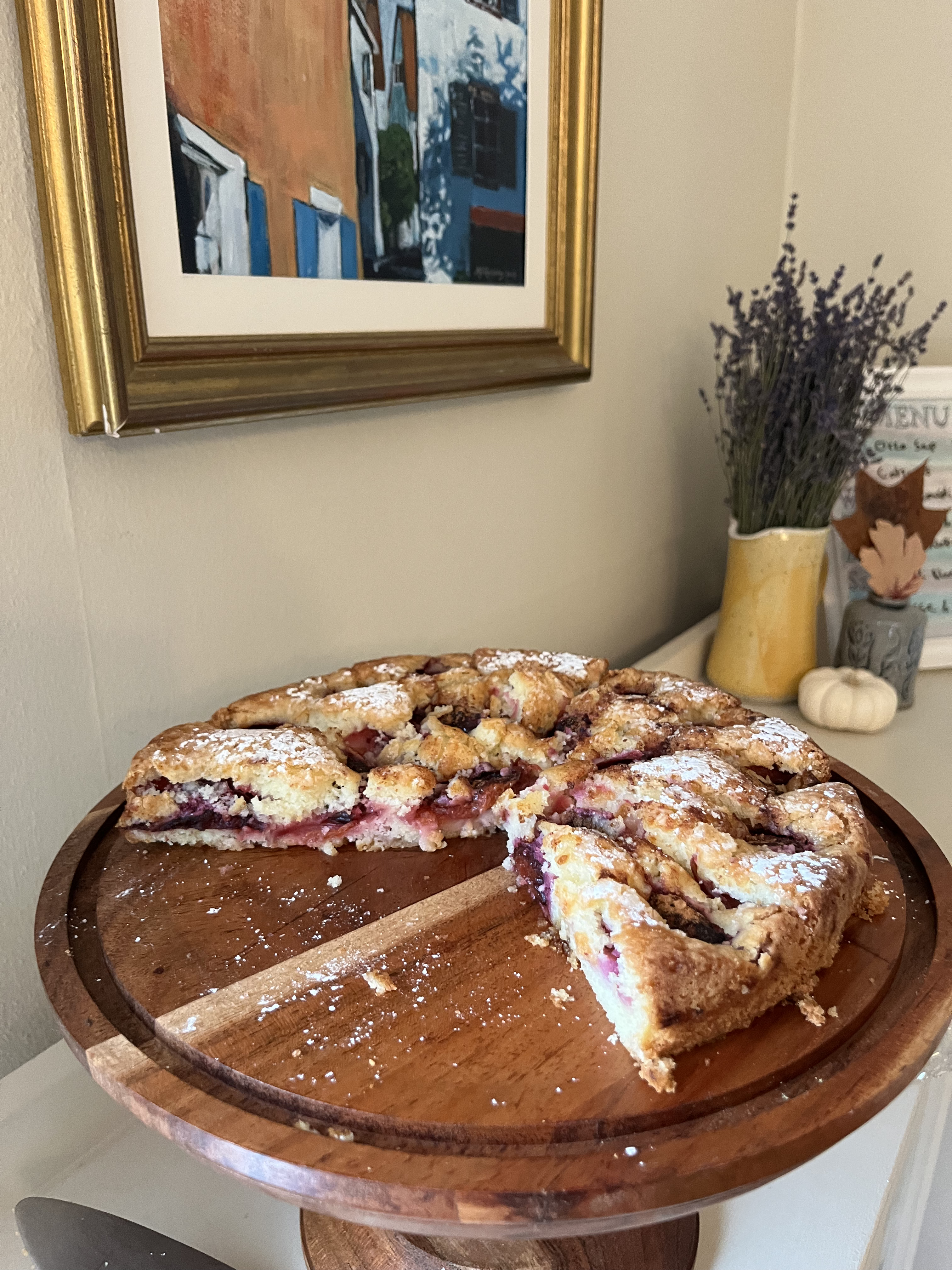
I reached up to pluck the plums I could reach from the ground, dreaming of making the plum torte so classic that the New York Times published it annually for decades before their newspaper archive could be easily accessed online. I had a big bowlful, enough for three tortes, actually, but that was fine. We’d just have three. I squinted up to where plums clung to branches far above my head, and thought about plum preserves, last year’s hot, sticky and ultimately unsatisfying project, which in any case would only use perhaps another bowl of plums. There were just so many plums.
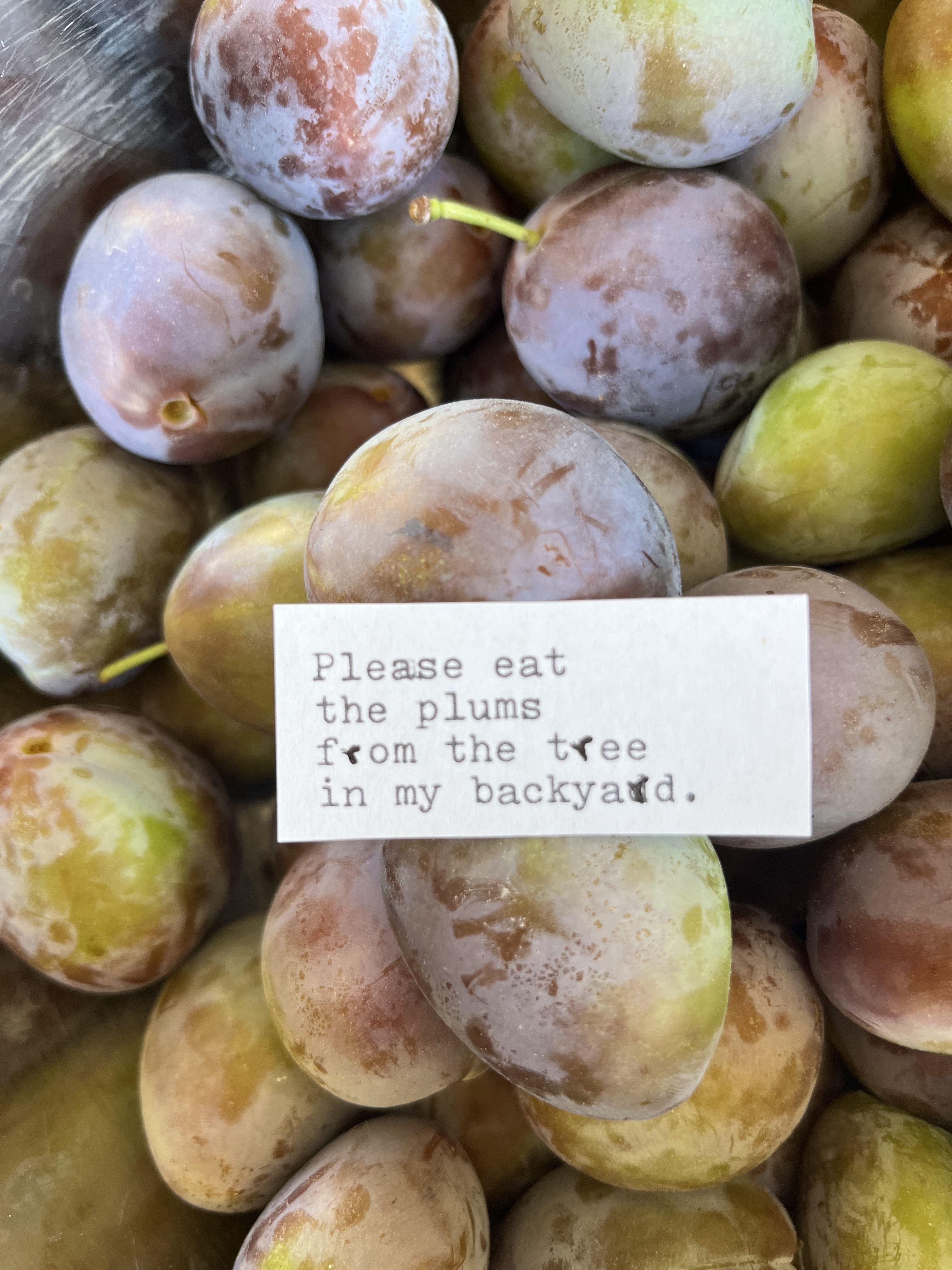
I wrote a poem about it, my own more generous version of William Carlos Williams’s “This is Just To Say” (above). “Take my plums!” I said to the world. The world didn’t answer, and the next day there were several dozen more squished plums on the ground for me to pick up and throw away. Above me, the purple multitudes were riper and riper, just days away from tumbling down en masse. I needed a new strategy.
It would be better, more generous, if I could say honestly that I immediately decided to share these plums with my neighbors in a practical, non-poem way, if I had never entertained the notion of picking them all and consigning most immediately to the capacious green bin in the corner of the yard. Someday, I hope to be the person whose first thought is generosity. For now, I’ll have to content myself with being the person who turns to generosity because food waste feels more unbearable than talking to strangers.
Years ago, the first summer we lived in our last home, the neighbor adjacent to us had invited my much-tinier daughters and me to help ourselves to her abundance of dahlias and sunflowers. At the time, I wrote another poem (as one should do with all gardening moments, perhaps), reflecting that while I wasn’t always sure what milestones of adulthood I was hoping to achieve anymore, growing enough of anything to share must certainly be part of it. Looking up at this plum tree, I realized this was my chance. In a small way, I could be the grown-up I’d aspired to be.
And it wasn’t romantic, really. It involved dragging a spidery ladder out of a spidery garage, dodging branches and getting scratched along the way. It was a sticky task, a dusty one, always with the chance that the ladder-spider and the tree spiders were whispering behind my back and plotting my demise.
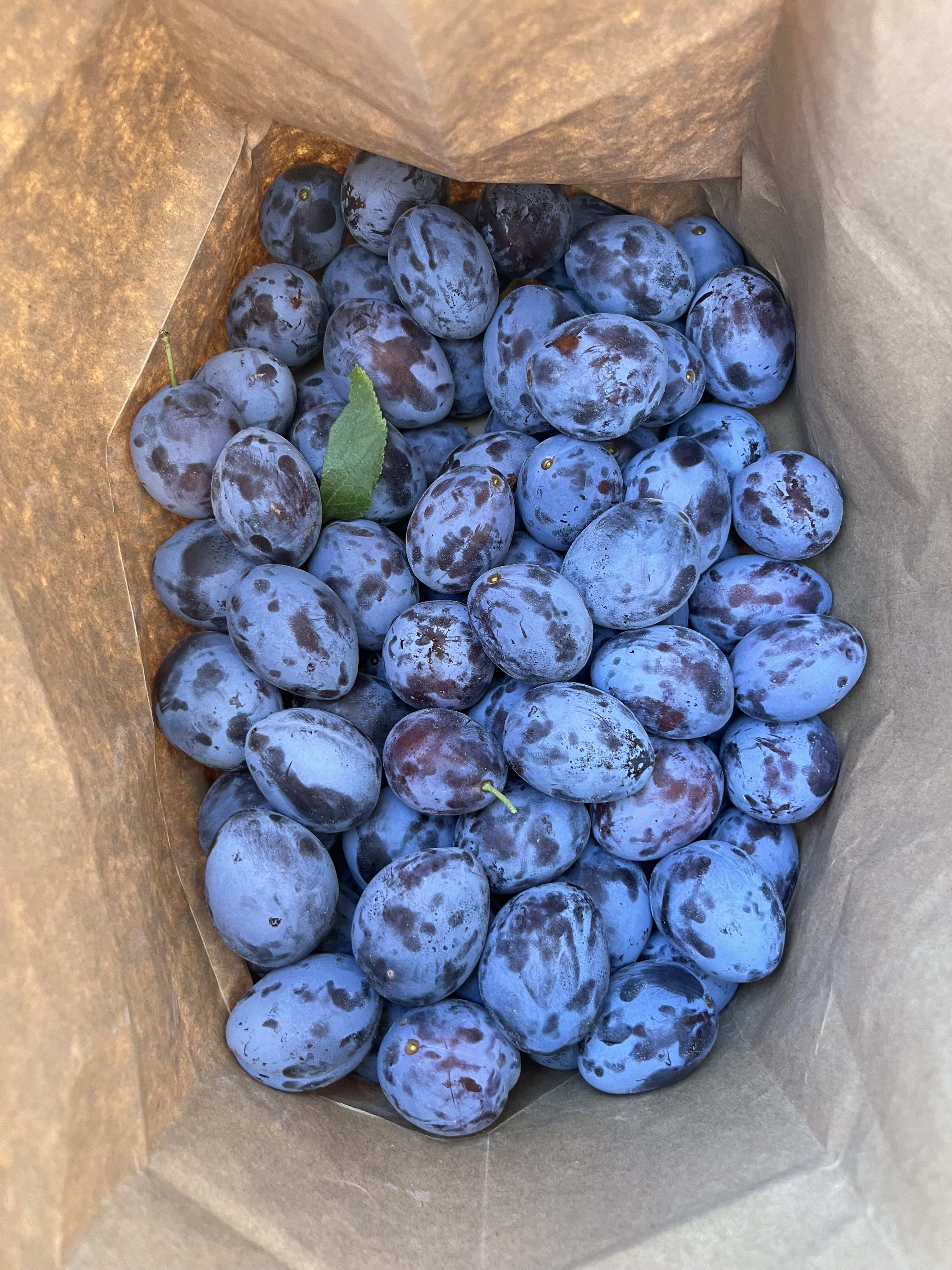
With eight grocery bags half-full, and all remaining plums outside even of my ladder-aided reach, I took to the internet’s answer to a spidery ladder, Facebook. On our local Buy Nothing page, I posted a picture of a full bag of plums, telling all interested parties to inquire privately for directions to pick up my extra plums (never being keen on posting my address in a group full of strangers, even neighbors). Within the course of an evening, I had seven takers, with another seven in the following days. I handed them out and chatted with neighbors, hearing about the plums they’d left at other homes, about the plums that were taken to a retirement home, the plums that were baked and pickled and dehydrated. For a week, it seemed all I talked about was plums, as I ran out of plums and directed neighbors to other neighbors, all of whom, it seemed had the bumper crop that I had. These plums, I learned, couldn’t be bought in stores, so could only be found this way, from a neighbor with both a surplus to share, and the motivation to make it happen.
Somewhere along the way, I realized that this fruit tree had transformed in my mind from a problem—these plums will become a sugary pulp on the ground if I don’t do something with them!—to a responsibility, something I could and should steward with care and intention. It’s been a summer of growing, living responsibilities for me, even more than usual, with kids and dogs, fish and house plants and garden to tend, and my living self alongside it all. At times I know I’ve considered each of these separately more as problems to solve, rather than gifts to share, but what if I didn’t?
I used to start the year with my honors English classes talking about the privileges and responsibilities that set them a bit apart in this advanced class, tracing the concept from Uncle Ben’s advice to Peter Parker (“With great power comes great responsibility”) all the way back to the Gospel of Luke (“To whom much was given, much will be required”). I never imagined that the great power, the much given to me would look like a fruit tree, or for that matter a home and little girls and rambunctious puppies and fish whose names I don’t know. But they are so much, their sheer abundance a responsibility all their own, to look out as much as I look in, to climb the ladder and get on Facebook and meet my neighbors with a grocery bag of ripe plums.
 The Way Home
Delightful!! Enjoy those hammock days. The plum tarte looks wonderful!! Shades of German bakeries!
Get Outlook for Androidhttps://aka.ms/AAb9ysg ________________________________